Policy Architecture and Program Design of Alabama’s Nursing Registered Apprenticeship Model
August 2026 | Julie Kornegay
The Workforce Challenge
A growing demand for nurses exposed a more complex challenge.
Expanding the nursing workforce requires more than preparing
additional nurses. Healthcare needs are experienced in specific
communities and facilities, while future nurses must move through
education, clinical preparation, licensure, and employment before
they can fully enter the profession.
The challenge is not only one of supply. It is also one of connection.
How do states connect people with nursing education, create
opportunities for advancement, and build stronger connections
between future nurses and the healthcare employers and communities
that need them?
In Alabama, that raised a new question
Could Registered Apprenticeship connect these pieces earlier?
Policy Brief Available Now
Explore the Research
Download the policy brief for the complete discussion, supporting
evidence, references, and policy implications.
Research continues.
Additional findings and full research papers from this project are
expected beginning in 2027.
Alabama’s nursing registered apprenticeship model was built through a sequence of policy actions rather than a single change. Federal apprenticeship requirements provided the workforce framework, while state law, nursing regulation, and nursing education rules established how students could participate in paid, supervised workplace learning before licensure.
Each layer answered a different question about how Registered Apprenticeship could operate within a regulated prelicensure nursing pathway.
01 Registered Apprenticeship Foundation
Federal Framework
Registered Apprenticeship supplied the employment and training structure.
Federal apprenticeship standards establish the framework for registered programs, including employment, supervised workplace learning, related instruction, progressive development, written program standards, and apprenticeship agreements.
Alabama created the state infrastructure for registering apprenticeship programs.
The Alabama Industry Recognized and Registered Apprenticeship Program Act established the Alabama Office of Apprenticeship and provided the state structure for registering apprenticeship programs and apprentices, supporting sponsors, and overseeing compliance.
State law created the legal basis for the Student Nurse Apprentice role.
Alabama Act No. 2021-275 expanded the Alabama Board of Nursing’s authority to establish standards for student nurse apprenticeships and issue permits to eligible nursing students.
Approved nursing education remained the foundation of apprentice preparation.
Nursing programs retain responsibility for curriculum, academic progression, competency validation, apprentice rosters, and clinical oversight. Board rules also allow apprenticeship learning to contribute to clinical education when the training is congruent with the approved clinical course.
Registered Apprenticeship did not replace nursing education or professional regulation. It created a structure in which education, employment, apprenticeship, and regulated prelicensure practice could operate together.
From Authority to Operation
Once the authority existed, program documents defined how the pathway would work in practice.
Part Two
Making the Model Operate
Legal authority made the pathway possible. Program documents defined
how sponsors, apprentices, and participating employers would carry it
out in practice.
The documents shown below are sample program documents provided by the
Alabama Office of Apprenticeship and illustrate how Registered
Apprenticeship requirements were translated into program operations.
Registered Apprenticeship Standards
The sample standards illustrate sponsor responsibilities, apprentice
agreements, registration and reporting requirements, records,
complaint procedures, and program administration.
Work Process Schedule and Related Instruction Outline
The sample Appendix A connects related instruction, competency
progression, progressive wages, apprentice to journeyworker ratios,
probationary requirements, and advancement milestones.
The sample Appendix B formalizes the individual apprentice’s
participation in the Registered Apprenticeship and incorporates
the registered program standards directly or by reference.
The sample Appendix D formalizes employer participation within the
sponsor administered program and identifies responsibilities for
workplace learning, supervision, documentation, and program
requirements.
These sample documents illustrate how Registered Apprenticeship
requirements were organized into a common operating structure for
higher education sponsors, apprentices, and participating healthcare
employers.
Why This Matters for Workforce Alignment
People. Place. Progression.
Alabama’s model created earlier connections among who can enter or
advance toward nursing, where that development takes place, and how
learning can become regulated workplace practice before licensure.
Each connection addresses a different part of the workforce challenge.
Workforce Alignment
A pathway is stronger when people, healthcare employers, and
opportunities to progress are connected earlier.
01
PEOPLE
Who can enter nursing or advance toward a nursing role?
Apprentices do not all begin from the same place. Some are new
entrants establishing a connection to a healthcare employer while
completing nursing education. Others are already working in
healthcare and use apprenticeship as a structured opportunity
to advance toward nursing.
The pathway can support both entry into healthcare employment
and advancement within the existing healthcare workforce.
02
PLACE
Where does workforce development actually occur?
Healthcare workforce needs are experienced by specific facilities
and communities. Apprenticeship connects the future nurse to a
participating healthcare employer while education is still underway,
allowing workplace development to occur in the setting where the
apprentice is employed.
Where apprenticeship opportunities are available matters because
the employer connection is tied to an actual healthcare workplace.
03
PROGRESSION
How does a student grow toward the nursing role?
The prelicensure structure creates space for development to occur
over time. Nursing education introduces new knowledge and skills.
Approved activities then move into supervised workplace practice,
where repetition, observation, feedback, and continued development
support progression.
The bridge to licensure is not a single step. It is a regulated
process of learning, practice, development, and advancement.
When People, Place, and Progression Connect
PEOPLE
Entry and advancement
PLACE
Employer and community connection
PROGRESSION
Development before licensure
The Alignment Effect
Workforce development can begin earlier and closer to where care is delivered.
New entrants can build a connection to a healthcare employer while
completing nursing education. Incumbent healthcare employees can
advance toward nursing within the workforce they already know.
Both can develop through a regulated prelicensure pathway before
final licensure.
Part Three
Supporting Participation
These mechanisms helped reduce financial barriers and support
participation by employers and apprentices.
Alabama Apprenticeship Tax Credit
During much of the study period, qualifying employers could receive
an Alabama apprenticeship tax credit for employing eligible
apprentices. The credit expired December 31, 2024.
Alabama Office of Apprenticeship policy applied available
scholarships, grants, tax credits, reimbursements, and other funding
offsets first, with remaining costs of training assigned to the
employer rather than the apprentice.
A later memorandum addressed apprentice work commitments and
established conditions intended to protect apprentices from
arrangements that function as debt or improperly restrict future
employment.
Laws and regulations established authority and safeguards.
Program documents translated requirements into an operating structure.
Participation supports helped reduce barriers for employers and apprentices.
Understanding those distinctions is essential to understanding how
Alabama’s model was built.
Shared Responsibility, Distinct Roles
One pathway depends on multiple systems working together.
Alabama’s nursing apprenticeship model does not place responsibility
with a single organization. Nursing regulation, education, employment,
and apprenticeship administration remain distinct while being
coordinated around the Student Nurse Apprentice.
Explore each partner to see what it is responsible for, how it connects
to the apprentice, and where its responsibility stops. Then select
Bring It Together to see how the complete system works
as one coordinated pathway.
Partner Spotlight
Alabama Board of Nursing
Establishes the regulatory boundaries for prelicensure nursing practice.
Primary Responsibility
Establishes eligibility, scope of practice, supervision,
competency requirements, standards of practice, and public
protection safeguards for Student Nurse Apprentices.
Connection to the Apprentice
Defines the conditions under which approved prelicensure nursing
activities may be performed, including required supervision and
applicable competency validation.
Institutional Coordination
Board requirements connect with approved nursing education,
employer supervision, and the Registered Apprenticeship structure
while regulatory authority remains with the Board.
What It Does Not Replace
The nursing education program, employer supervision
responsibilities, Registered Apprenticeship administration,
or the requirements for final nursing licensure.
Why It Matters
The Board makes regulated prelicensure practice possible while
preserving the safeguards expected of nursing education and
professional regulation.
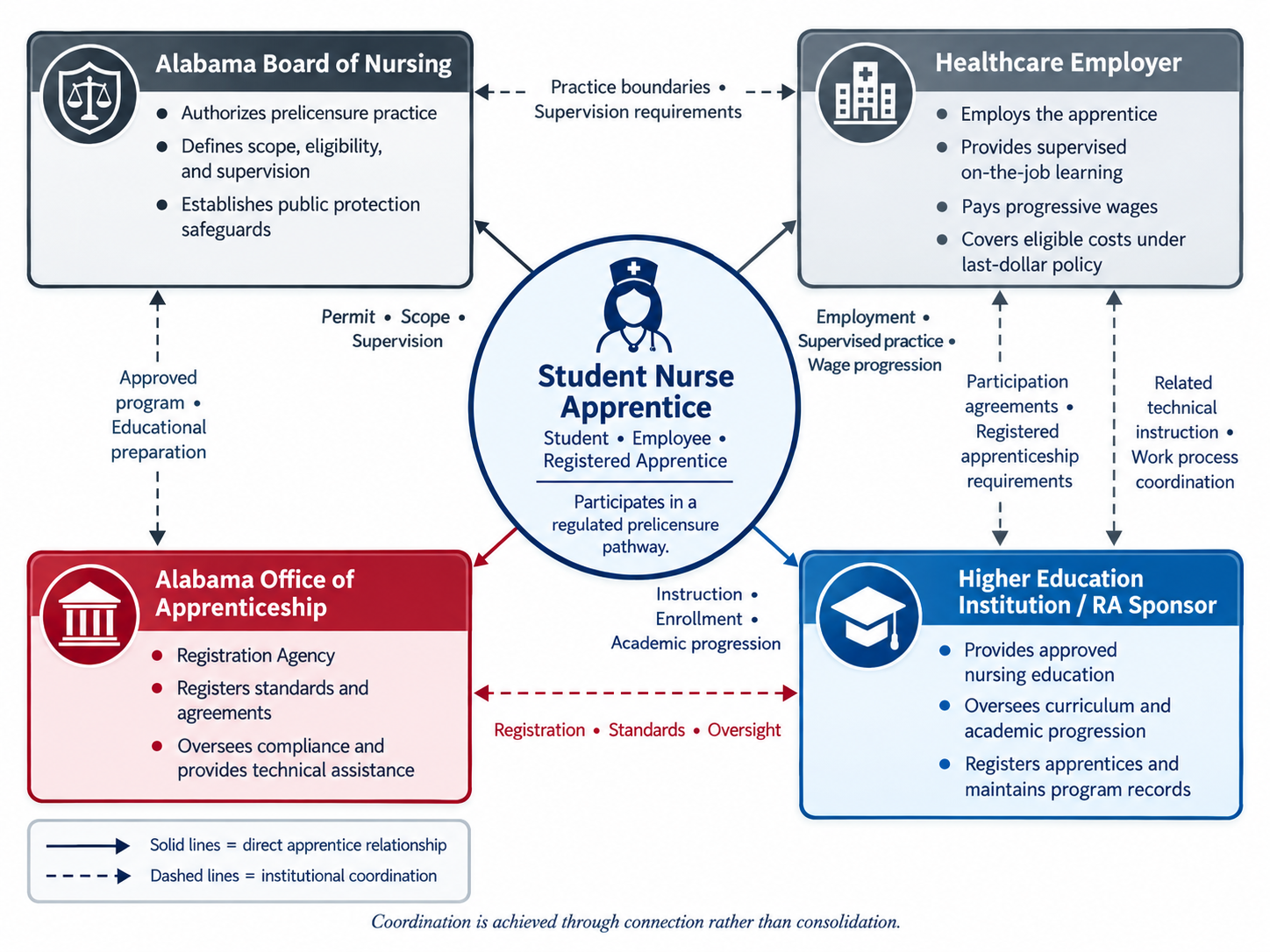
How the Relationships Connect
One apprentice. Multiple systems. Distinct responsibilities.
Solid lines show direct relationships with the Student Nurse
Apprentice. Dashed lines show coordination among the participating
institutions.
The Board connects directly to the apprentice through permitting,
scope of practice, and supervision requirements. It also coordinates
with higher education and employers so workplace practice remains
connected to approved nursing education and regulatory requirements.
Partner Spotlight
Higher Education Institution and RA Sponsor
Connects approved nursing education with the Registered
Apprenticeship structure.
Primary Responsibility
Provides approved nursing education and remains responsible
for curriculum, academic progression, applicable competency
requirements, and the educational preparation of participating
nursing students.
Connection to the Apprentice
Connects instruction, enrollment, academic progression, and
apprenticeship participation so the apprentice remains a nursing
student while gaining structured paid workplace experience.
Institutional Coordination
As the Registered Apprenticeship sponsor, the institution
administers the apprenticeship, maintains required program
records, and coordinates participating employers within the
registered program structure.
What It Does Not Replace
The Board of Nursing’s authority over prelicensure practice,
the employer’s responsibility for paid supervised workplace
learning, Alabama Office of Apprenticeship oversight, or the
requirements for final nursing licensure.
Why It Matters
Apprenticeship is integrated into approved nursing education
rather than operating as a separate training pathway. Education
remains the foundation while sponsorship creates a structured
connection to workplace learning and employer participation.
How the Relationships Connect
Education remains the foundation while apprenticeship connects
learning to employment.
Solid lines show direct relationships with the Student Nurse
Apprentice. Dashed lines show coordination among the participating
institutions.
Higher education connects directly to the apprentice through
instruction, enrollment, and academic progression. As the
Registered Apprenticeship sponsor, the institution also connects
education with employer participation and the administrative
requirements of the registered program.
Partner Spotlight
Healthcare Employer
Provides paid, supervised workplace learning within the regulated
apprenticeship pathway.
Primary Responsibility
Employs the apprentice and provides paid, supervised on the job
learning within the practice boundaries established for the
Student Nurse Apprentice role.
Connection to the Apprentice
Provides repeated supervised workplace experience, observation,
feedback, and progressive responsibility as approved skills and
apprenticeship milestones are completed.
Institutional Coordination
Participates within the higher education sponsor’s Registered
Apprenticeship structure and coordinates workplace learning,
supervision, work processes, documentation, and program
requirements with the sponsor.
What It Does Not Replace
The nursing education program, Board of Nursing authority over
prelicensure practice, Registered Apprenticeship registration and
oversight, or the requirements for final nursing licensure.
Why It Matters
Employers create the sustained workplace connection that allows
apprentices to build experience, earnings, and proficiency while
progressing toward licensure.
How the Relationships Connect
Employment turns approved preparation into sustained workplace
experience.
Solid lines show direct relationships with the Student Nurse
Apprentice. Dashed lines show coordination among the participating
institutions.
The employer connects directly to the apprentice through
employment, supervised practice, and wage progression. The
employer also coordinates with the higher education sponsor
through participation agreements, work process requirements,
related instruction, and apprenticeship documentation.
Participation Support
Under AOA’s Cost of Training policy, available scholarships,
grants, tax credits, reimbursements, and other offsets could be
applied first, with remaining costs of training assigned to the
employer rather than the apprentice.
Partner Spotlight
Alabama Office of Apprenticeship
Registers and oversees the Registered Apprenticeship structure
that supports the nursing pathway.
Primary Responsibility
Registers and oversees Registered Apprenticeship programs,
monitors compliance with apprenticeship requirements, and
provides technical assistance within Alabama’s apprenticeship
system.
Connection to the Apprentice
The apprentice participates in a Registered Apprenticeship
operating within the state registration system. AOA provides
the apprenticeship oversight that supports registration,
standards, agreements, and required program administration.
Institutional Coordination
AOA works with the higher education sponsor through registration,
standards, oversight, compliance, and technical assistance while
participating employers operate within the sponsor administered
Registered Apprenticeship structure.
What It Does Not Replace
The Board of Nursing’s authority over prelicensure practice,
the nursing education program, the higher education institution’s
sponsor responsibilities, employer supervision, or final nursing
licensure requirements.
Why It Matters
AOA provides the state apprenticeship infrastructure that allows
the nursing pathway to operate as a Registered Apprenticeship while
nursing education and professional regulation remain with the
organizations responsible for them.
How the Relationships Connect
Apprenticeship administration connects the partners without
consolidating their responsibilities.
Solid lines show direct relationships with the Student Nurse
Apprentice. Dashed lines show coordination among the participating
institutions.
AOA connects to the apprentice through the Registered Apprenticeship
system and connects institutionally with the higher education sponsor
through registration, standards, and oversight. Its role is to govern
the apprenticeship structure, not nursing education or nursing
practice.
Bringing It Together
One pathway. Four systems. Distinct responsibilities.
Alabama’s model connects nursing regulation, education,
employment, and apprenticeship administration around the
Student Nurse Apprentice without transferring the core
responsibilities of one system to another.
The Student Nurse Apprentice is directly connected to
nursing regulation, approved education, employment, and
the Registered Apprenticeship structure.
Dashed Lines
Institutional coordination
The participating organizations coordinate standards,
education, workplace learning, supervision, registration,
and program requirements while retaining distinct authority.
Distinct Roles Within One Pathway
Coordination works because responsibility remains clear.
Alabama Board of Nursing
Regulates prelicensure practice
Establishes eligibility, scope, supervision,
competency requirements, and public protection safeguards.
Higher Education
Provides education and sponsorship
Retains responsibility for nursing education and academic
progression while administering the Registered Apprenticeship.
Healthcare Employer
Provides paid workplace learning
Employs the apprentice and provides supervised on the job
learning, workplace experience, and wage progression.
Alabama Office of Apprenticeship
Provides registration and oversight
Registers and oversees the Registered Apprenticeship
structure and provides compliance and technical assistance.
Core Finding
Shared responsibility does not mean blurred responsibility.
Alabama’s model connects nursing regulation, apprenticeship
administration, education, and employment while preserving
the distinct role each organization plays within the pathway.
Why the Architecture Matters
No single organization controls the entire pathway. The model works
by connecting organizations with different responsibilities around
the apprentice while preserving the regulatory, educational,
employment, and apprenticeship functions each is responsible for.
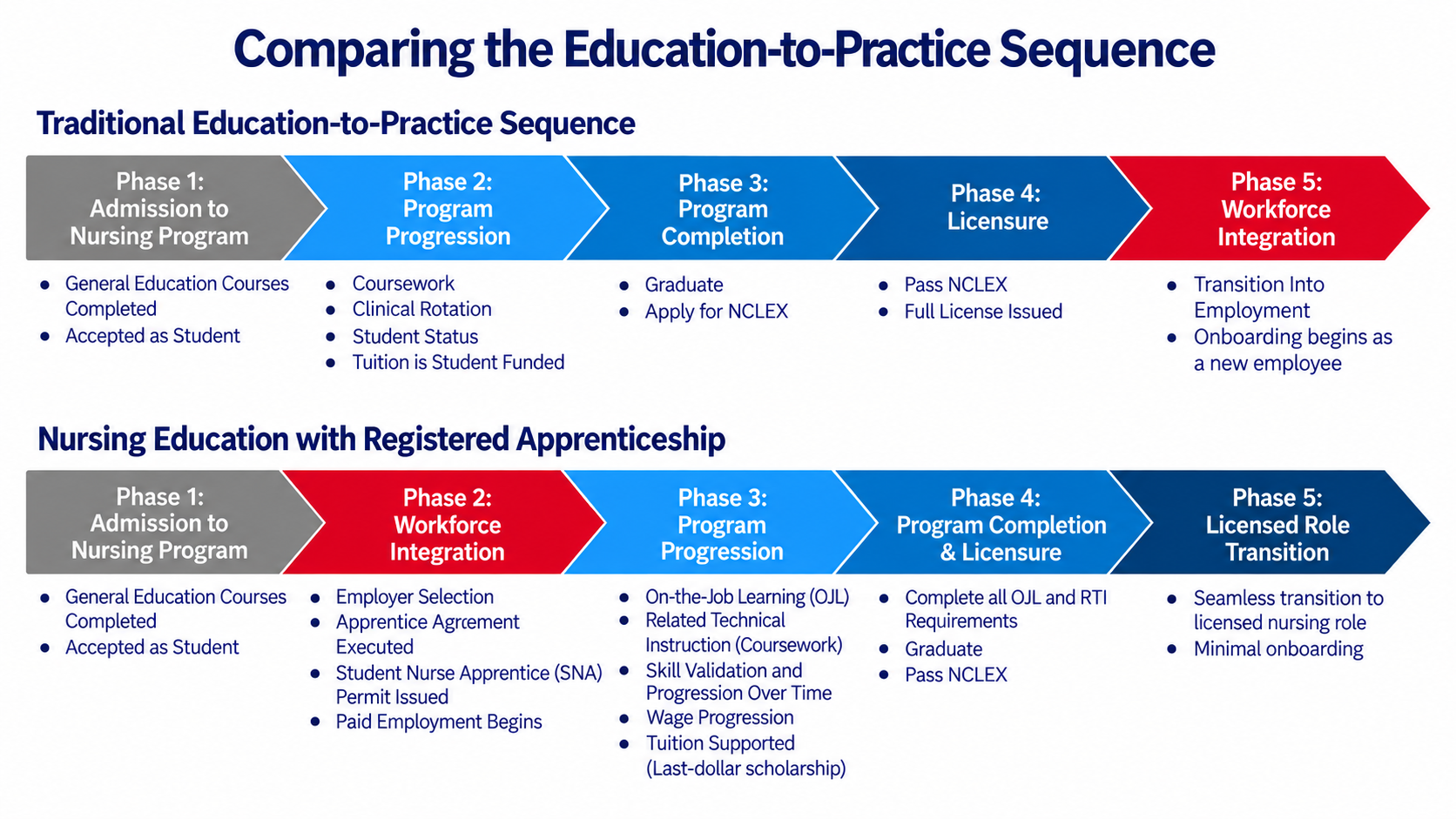
Moving Practice Upstream
Workplace learning begins earlier in the nursing pathway.
In a traditional education to practice sequence, the sustained
connection to employment typically comes after program completion
and licensure. Alabama’s nursing apprenticeship model creates that
connection earlier, allowing eligible nursing students to participate
in paid, supervised workplace learning while continuing to progress
through an approved nursing program.
The nursing program remains the foundation. What changes is when
structured workplace learning begins. After required education and
applicable competency requirements have been met, approved nursing
activities can become part of supervised workplace practice.
Repeated experience, feedback, and progressive responsibility can
then develop before final licensure rather than beginning only after
graduation.
Core Takeaway
The model does not move licensure earlier. It moves structured
workplace preparation earlier.
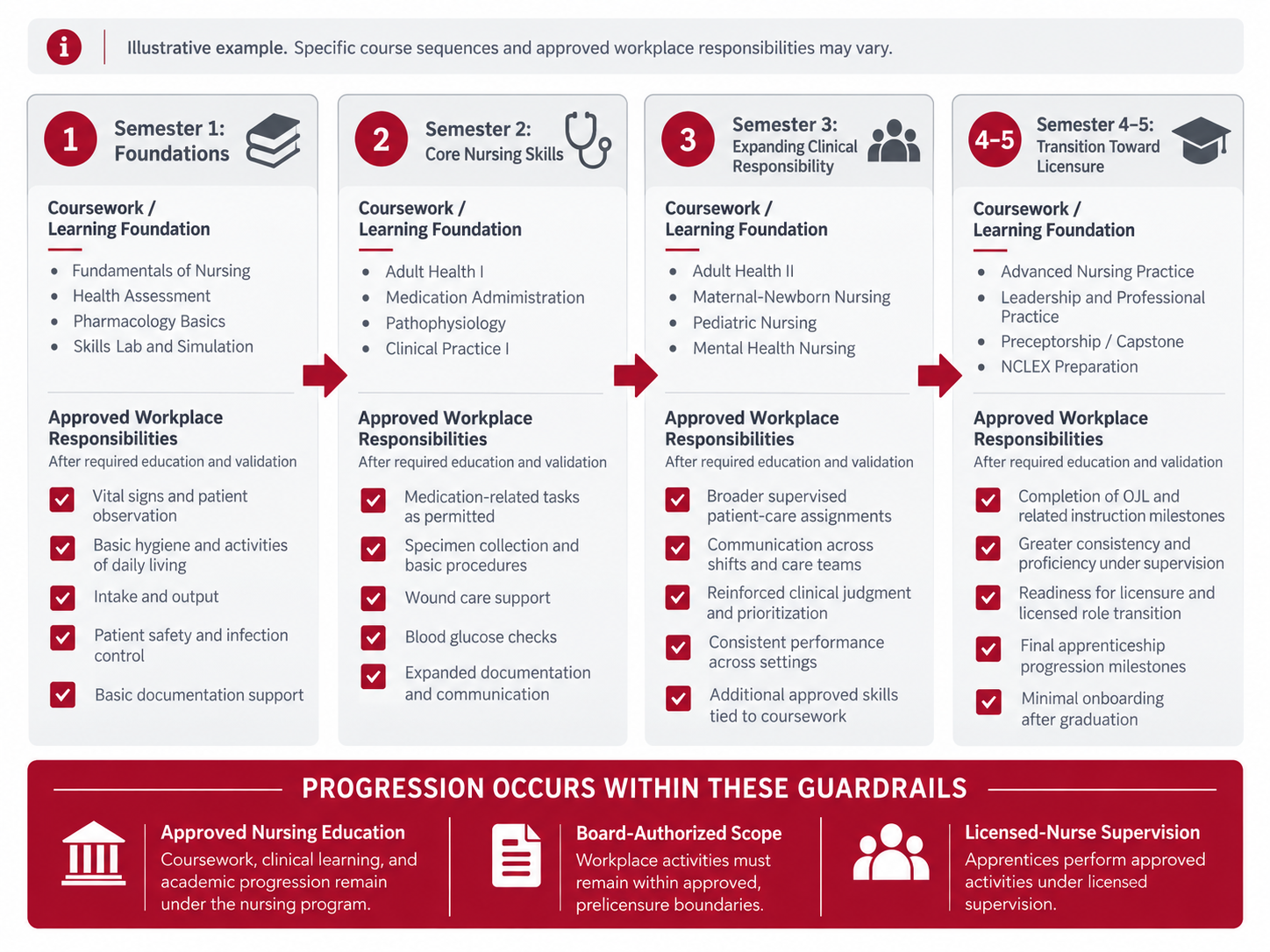
From Learning to Competency
Progression builds through education, supervised practice, and repeated experience.
As apprentices progress through nursing coursework and meet applicable
education, validation, and workplace milestones, they can take on
additional approved responsibilities within the regulated prelicensure
role. Progression occurs over time as education and supervised workplace
experience work together.
Education establishes the foundation for approved practice.
Supervised workplace experience then provides opportunities for
repetition, observation, feedback, and increasing proficiency.
Responsibility expands only as applicable education, competency,
and apprenticeship milestones are met.
Core Takeaway
Competency develops over time. Responsibility expands within
established prelicensure guardrails.
Why These Findings Matter
The architecture changes how education, employment, and regulated practice connect.
Alabama’s model is more than employment added to nursing school.
It creates a coordinated pathway that connects approved education,
regulated prelicensure practice, paid workplace learning, and
progression toward licensure while preserving the responsibilities
of each participating system.
For Policymakers
Licensed occupations require more than an apprenticeship framework.
Registered Apprenticeship can organize employment, learning, and
progression, but professional practice still depends on the
appropriate legal and regulatory authority. Alabama’s model shows
how those systems can be connected without combining their distinct
responsibilities.
For Higher Education
Education remains the foundation of the pathway.
Apprenticeship creates a structured connection between approved
nursing education and paid workplace learning while the nursing
program retains responsibility for curriculum, academic progression,
and educational preparation.
For Healthcare Employers
Workforce connection can begin before licensure.
Employers can hire eligible nursing students and provide paid,
supervised workplace experience while they continue their education.
This creates an earlier connection between future nurses and the
facilities where they may continue working after licensure.
For Apprentices and Communities
Education, earnings, and workplace experience can develop together.
Apprentices can earn wages and build supervised workplace experience
while completing nursing education. The pathway also creates a
stronger connection between nursing preparation, employment, and
the healthcare organizations serving communities across the state.
The Larger Lesson
The value of the model lies in the connections it creates while
keeping responsibility for regulation, education, employment, and
apprenticeship clearly defined.
Continue the Research
Explore the Brief or Connect with EPC
Download the research brief for the full discussion, supporting
evidence, references, and policy implications, or connect with the
Education Policy Center to learn more about this work.