
From Pilot to Scale
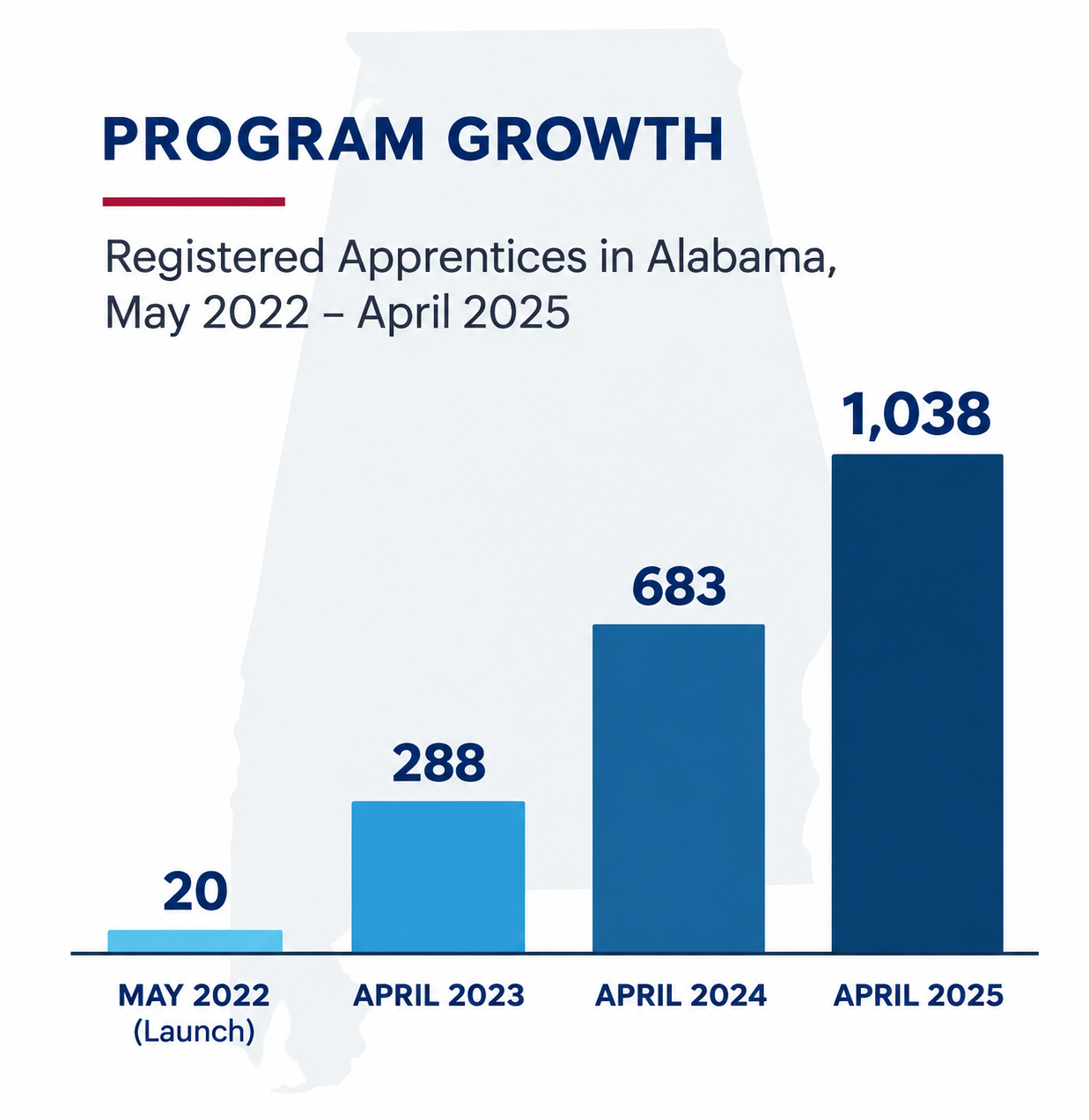
Alabama’s Nursing Registered Apprenticeship Program launched in May 2022 with 20 apprentices. By April 2025, the study cohort included 1,038 apprentices across 21 participating higher education institutions and a statewide network of more than 70 healthcare employers. Growth therefore extended across the education and healthcare systems supporting apprenticeship, not enrollment alone.
Participation Patterns Differ Across Pathways
The demographic profile of Alabama’s nursing apprenticeship is not uniform across pathways. Racial composition differs substantially between the RN and LPN pathways, while gender composition remains comparatively similar.

Multiple Points of Entry Into the Nursing Labor Market
Alabama’s nursing apprenticeship is reaching people at very different stages of their education and working lives. Participation includes young adults moving into nursing education soon after completing high school as well as adults entering the pathway later in adulthood.
Earlier Entry Into Nursing
Adult Entry and Workforce Mobility
Labor Market Implications of Who Participates
These demographic patterns matter because nursing labor supply is shaped not only by how many people are trained, but also by who can enter the occupation, when they enter, and which pathways connect them to employment. Alabama’s nursing apprenticeship is engaging participants across different age groups and demographic populations, creating multiple potential sources of nursing labor.
Earlier Entry Can Strengthen the Connection Between Education and Employment
Apprentices who entered at ages 18 and 19 had already completed the general education coursework required for nursing program admission. A more direct transition into nursing education and paid employment can reduce gaps between education and labor market entry while allowing participants to begin accumulating occupational experience and earnings earlier. Over time, earlier entry may also increase cumulative earnings and years of nursing work experience.
Adult Entry Broadens the Potential Labor Supply
More than half of apprentices entered at age 25 or older, with participation extending into the 50s and beyond. This shows that nursing apprenticeship can draw potential workers from beyond the traditional college age population. For adults already participating in the labor market, apprenticeship may provide a structured route to develop new skills, earn a nursing credential, or move into a higher wage occupation. For employers, this expands the potential recruitment pool beyond new labor market entrants.
Different Pathways Reach Different Segments of the Labor Pool
The RN and LPN pathways have substantially different racial compositions, showing that the two pathways are reaching different participant populations. From a labor market perspective, this matters because expanding nursing supply may depend on multiple education and occupational routes that connect different groups of potential workers to nursing employment. Broader representation may also contribute to a nursing workforce that more closely reflects and understands the communities it serves.
Lower Male Participation Signals Additional Labor Supply Potential
Men account for 9.1% of apprentices, indicating that they remain comparatively underrepresented in the nursing apprenticeship population. In a labor market with sustained demand for nurses, increasing participation among groups that remain underrepresented could broaden the recruitment base. The current data do not identify why participation differs by gender, but they establish an important workforce development question for future study.
Understanding What These Findings Can and Cannot Tell Us
These findings establish a demographic baseline for registered apprentices who participated in Alabama’s nursing apprenticeship during the study period. The questions below clarify several important boundaries of the analysis.
Do these findings describe applicants or registered apprentices?
The findings describe registered apprentices included in the study cohort. They do not represent everyone who considered nursing, applied to a nursing program, applied for an apprenticeship opportunity, or was eligible to participate.
What can these findings tell us about access?
Participation patterns can show which populations are represented among registered apprentices, but participation is not the same as access. The data do not identify everyone who wanted to participate, whether apprenticeship opportunities were equally available across communities, or whether individuals encountered barriers before entering the program.
Do differences in representation tell us why people entered apprenticeship?
No. The administrative data show who participated and how participation differed across demographic groups and pathways. They do not establish whether those patterns resulted from recruitment, individual choice, program availability, institutional practices, prior educational experiences, or other factors.
Who Stays?
The next analysis moves from who participates to who remains in the program. It examines the characteristics of apprentices who are retained and identifies patterns associated with continued participation, providing a clearer picture of persistence across Alabama’s nursing registered apprenticeship.

Continue Exploring Alabama’s Nursing Registered Apprenticeship
Download the demographic brief for additional findings, supporting evidence, references, and policy context, or explore the broader nursing registered apprenticeship research series.