Closing The Gap Between Nursing Workforce Supply and Demand
Aligning Workers, Education, Employers, and Communities
July 2026 | Julie Kornegay
This research begins by examining the scope of the nursing workforce shortage and the forces that shape it. Rather than treating the shortage as simply a gap between open positions and available nurses, it considers how nursing supply is built through education, clinical preparation, licensure, employment, and continued participation in the workforce.
The analysis then looks at where that system can become constrained, including education capacity, geographic access, workforce participation, and opportunities for advancement. From there, it examines how apprenticeship can strengthen connections among workers, higher education, employers, and communities at different points along the nursing pathway.
The goal is to understand the problem first, then consider where stronger alignment can expand nursing workforce capacity.
Image AI Generated
Nursing Workforce Supply and Demand
Nursing Workforce Supply, Demand, and the Pathways That Connect Them
Nursing workforce demand does not automatically create additional nursing supply. Preparing more nurses depends on the capacity of education, clinical training, licensure, and employment systems to help people enter, progress through, and remain connected to the profession.
U.S. Bureau of Labor Statistics projections estimate approximately 189,100 RN openings each year from 2024 to 2034. At the same time, the American Association of Colleges of Nursing reported 80,162 qualified nursing school applications that were not accepted in 2024, illustrating how education and clinical training capacity can limit the number of people able to enter the profession.
Alabama faces the same alignment challenge at the state level. Alabama Board of Nursing projections identified 38,725 expected workforce losses from 2023 to 2027 compared with 32,170 expected gains through examination and endorsement, creating a projected replacement gap of 6,555 nurses before accounting for additional growth in demand.
Workforce pressures are also unevenly distributed. Statewide nursing totals can mask shortages in the communities where demand is greatest, particularly in nonmetropolitan areas where education access, clinical training opportunities, transportation, and local employment pathways may be more limited. Federal health workforce projections estimate an RN shortage of approximately 11% in nonmetropolitan areas by 2038, compared with about 2% in metropolitan areas. This difference reinforces the importance of where education, training, and employment pathways are available and how geography shapes a community’s ability to build and sustain nursing workforce capacity.
At a Glance
Key Indicators of Nursing Workforce Pressure
189,100
Projected RN openings each year, 2024 to 2034
80,162
Qualified nursing school applications not accepted in 2024
6,555
Projected Alabama nurse replacement gap, 2023 to 2027
~11% vs. ~2%
Projected RN shortage in nonmetropolitan versus metropolitan areas by 2038
Sources:
U.S. Bureau of Labor Statistics, American Association of Colleges of Nursing, Alabama Board of Nursing, and federal health workforce projections. Full citations are available in the research brief.
Understanding the Imbalance
Demand Does Not Automatically Expand Nursing Supply
Employers can respond quickly when demand for nurses rises by increasing hiring, raising wages, offering incentives, or competing more aggressively for available workers. But these actions do not immediately increase the number of nurses available to work.
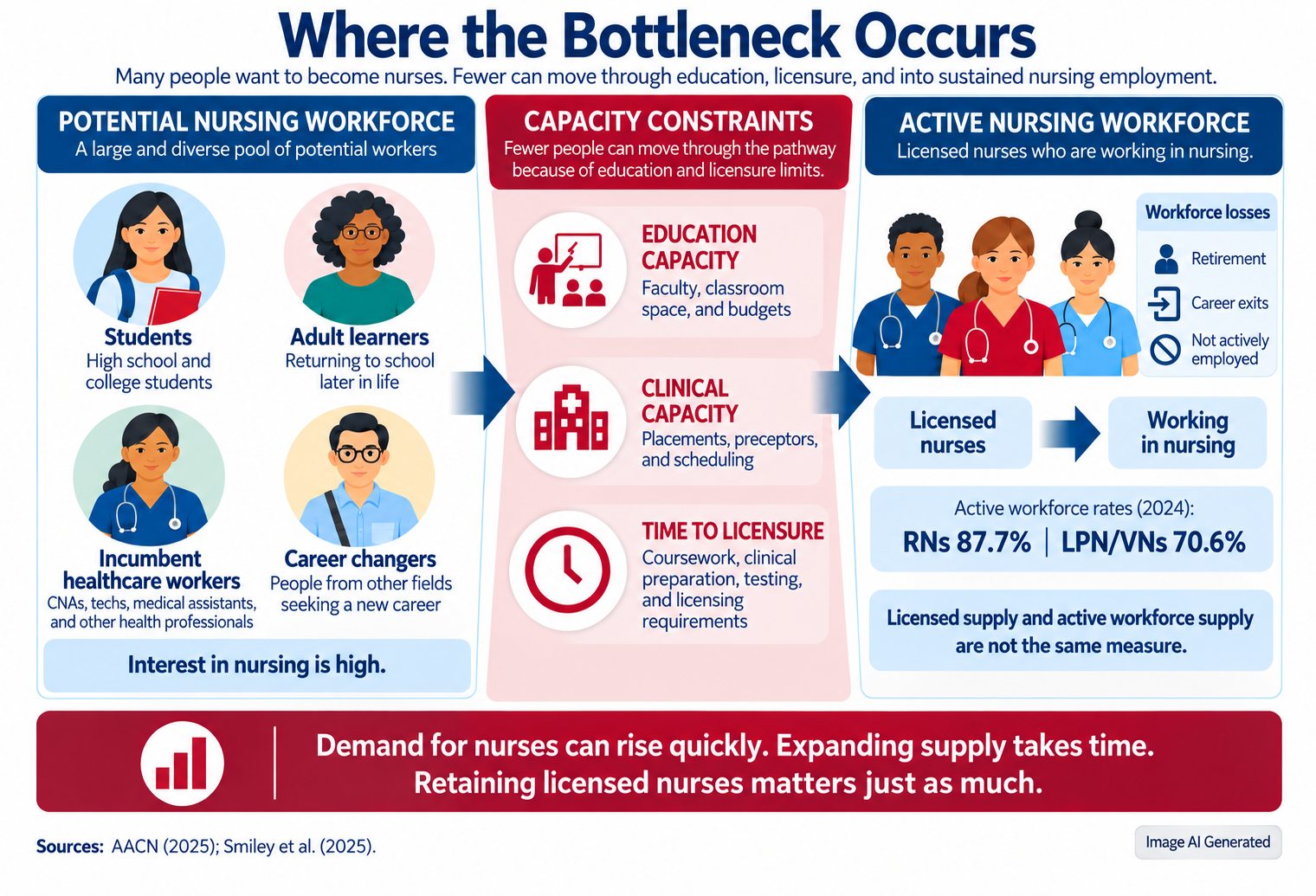
Nursing supply depends on both entry into the profession and continued participation in the workforce. New nurses must complete approved education, clinical preparation, and licensure before entering practice, and nursing schools continue to report capacity constraints that limit how quickly interested students can move into the profession.
What the Data Tell Us
87.7%
of RN licensees were actively employed in nursing
70.6%
of LPN licensees were actively employed in nursing
Licensure alone does not equal workforce participation. Nursing supply also depends on whether licensed nurses remain employed in nursing roles.
Select the illustration to view it at full size.
The Supply Challenge Is More Than Producing New Nurses
In 2025, U.S. schools of nursing reported 93,176 qualified applications that were not accepted, citing insufficient faculty, clinical placement sites, preceptors, classroom space, and budget constraints as major barriers to enrollment. That was 13,014 more applications than in 2024, a 16.2% increase. AACN reports applications rather than unique applicants, so one individual may be represented in more than one application.
Supply is also affected after licensure. National workforce data show that some licensed nurses are not actively employed in nursing, and more than 138,000 nurses left the nursing workforce between the 2022 and 2024 national surveys. A stronger nursing supply response therefore depends on both expanding pathways into the profession and supporting nurses’ continued participation in the workforce.
93,176
Qualified applications not accepted
Nursing schools cited faculty, clinical placements, preceptors, space, and budgets among the constraints.
138,000+
Nurses left the workforce
More than 138,000 nurses left nursing between the 2022 and 2024 national workforce surveys.
Place Matters
Geography Shapes Nursing Workforce Capacity
Geography also affects how well nursing supply aligns with employer demand. National projections show substantially larger RN shortages in nonmetropolitan than metropolitan areas, illustrating how statewide workforce totals can mask local shortages.
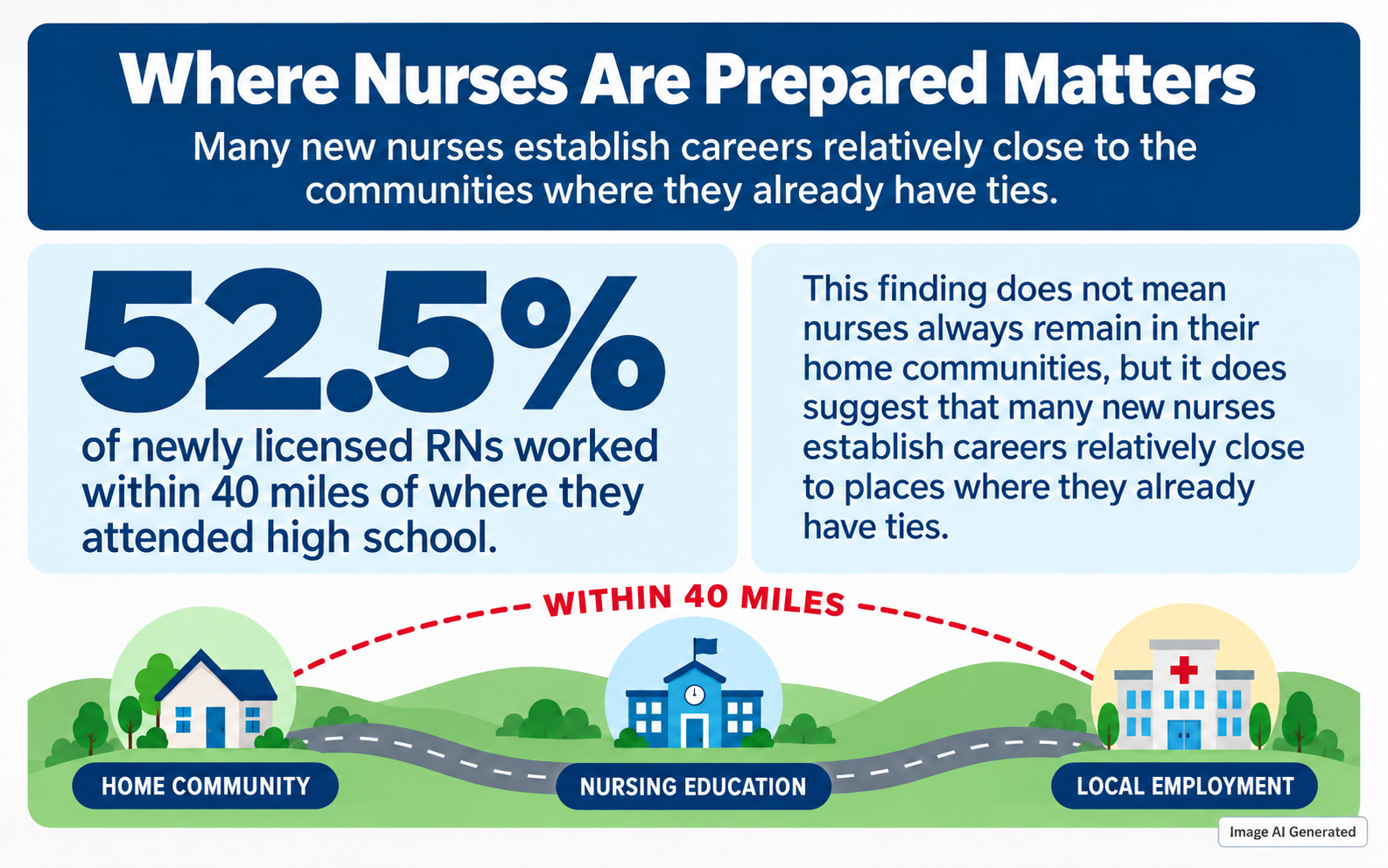
Increasing the number of nurses statewide does not necessarily increase supply in the communities facing the greatest need because workforce capacity develops where education, clinical training, employment opportunities, and work connected pathways are accessible.
For employers and communities, the central issue is therefore not only how many nurses are produced, but whether nursing supply develops in the places where labor demand exists.
The Central Point
Nursing workforce supply is built locally.
Accessible education and employment connected training help communities build nursing supply where demand is greatest.
Select the illustration to view it at full size.
Local access can shape where nursing careers begin.
Geography as a Workforce Barrier
Distance can increase both the financial and time cost of entering nursing.
For working adults and rural residents, entering a nursing program can require balancing school with employment, caregiving, transportation, and clinical placement requirements.
$18,300 to $19,600
Estimated direct program costs
Published 2025 estimates from two Alabama public associate degree nursing programs, before transportation and some additional expenses.
~$1,680
Estimated vehicle cost
A 40 mile round trip twice a week over 30 weeks, calculated using the 2025 IRS mileage benchmark.
Where nursing pathways are located influences who can enter the profession and where workforce capacity develops.
Building From Within
Untapped Potential in the Existing Workforce
The existing healthcare workforce is not just a labor pool. It is a foundation for nursing workforce development.
Developing this workforce creates economic value because it builds on human capital workers already possess. Education, credentials, and workplace learning can expand that capacity, helping workers move into occupations requiring greater skill, responsibility, and earning potential.
Career pathways organize this progression into connected steps, allowing workers to earn recognized credentials, advance to higher skilled jobs, and contribute more fully to employers and communities.
Career Pathway
Building on Experience Through Education and Credentials
Nursing Assistant
$42,260
2025 median annual wage
→
LPN or LVN
$64,400
2025 median annual wage
→
Registered Nurse
$97,550
2025 median annual wage
Median annual wages shown for 2025. Individual career paths and earnings vary.
For Individuals
Career pathways can expand economic mobility.
Healthcare occupations offer a visible career ladder in which workers can build on existing experience through additional education and credentials.
For Employers
Developing talent from within can expand skilled workforce capacity.
Career pathways give employers another option besides competing for workers who already hold scarce credentials.
For Communities
Human capital can reinforce local economic growth.
When local workers gain skills and move into higher wage occupations, households gain earning power, employers benefit from a stronger workforce, and more income can circulate through the local economy.
Understanding Program Design
Nursing Apprenticeship Is Not a Single Model
Developing local nursing talent requires structures that connect education, paid work, and advancement. Registered Apprenticeship is one model for making that connection, but its structure in nursing varies considerably.
Programs can begin at different points in the nursing pathway and differ in how practice is authorized, how education and employment are connected, how apprentices advance, and how programs are organized and scaled.
Two programs may both be called nursing apprenticeships while providing very different experiences. Before comparing outcomes, we first need to understand what is being compared.
Healthcare Apprenticeship
36,892
Registered apprentices served in healthcare in 2025
43%
Increase in healthcare registered apprentices over five years
Same Goal. Different Architecture.
Apprenticeship Can Enter the Nursing Pathway at Different Points
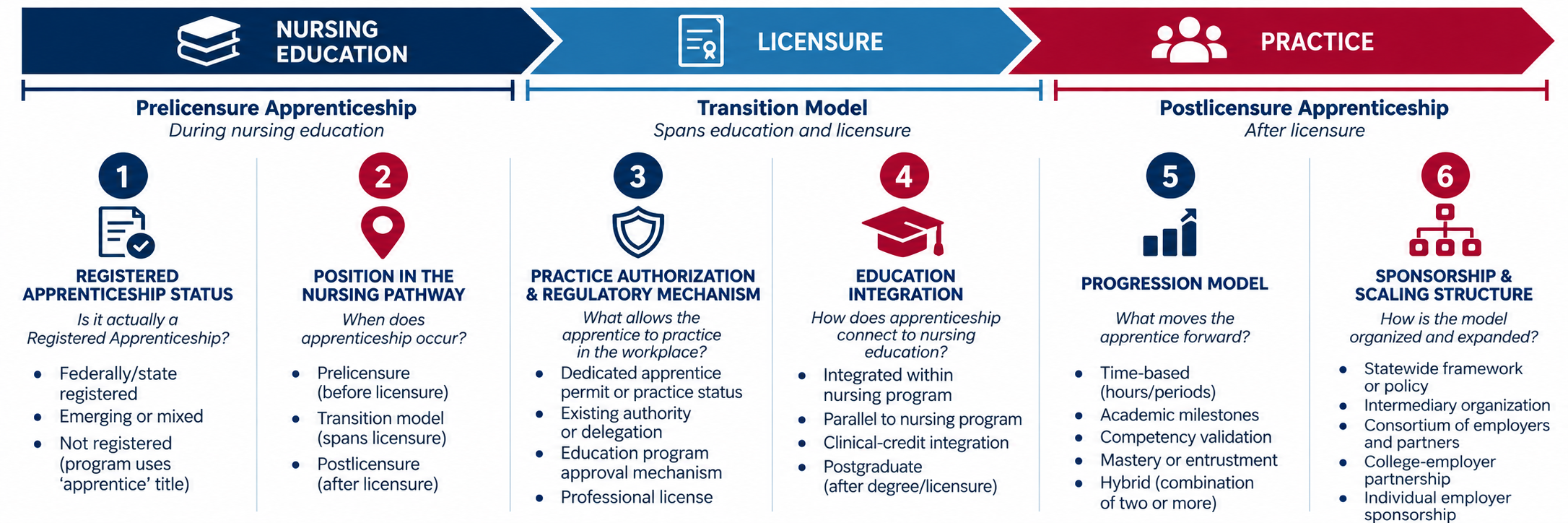
The framework below shows six design dimensions that help distinguish nursing apprenticeship models. Together, they show where apprenticeship enters the pathway and how education, practice authorization, progression, and sponsorship can differ across models.
Select the illustration to view it at full size.
Three broad entry points shape what an apprenticeship model is positioned to do.
Prelicensure models connect nursing education with paid employment and workplace learning before licensure. Transition to practice models support movement from nursing education into licensed practice. Postlicensure models help nurses who are already licensed develop additional skills and continue progressing in the workforce.
Why the Distinction Matters
The point at which apprenticeship occurs determines which part of the nursing workforce problem it is positioned to address.
A prelicensure nursing student working under regulated practice authority is fundamentally different from a licensed RN completing a postlicensure apprenticeship. Understanding program architecture is therefore essential before comparing implementation, participation, or outcomes across nursing apprenticeship models.
Healthcare apprenticeship data and the program design framework are documented in the full research brief.
Bringing the Pieces Together
From Nursing Shortage to Workforce Alignment
The nursing workforce challenge does not occur at a single point. Potential workers must first enter nursing education, students must progress through education and licensure, employers need access to qualified new nurses, and licensed nurses need opportunities to advance and remain connected to the workforce.
Apprenticeship can support each of these stages, but its value depends on where the model is positioned within the workforce pathway and which challenge it is designed to address.
Viewed together, the findings presented across this research point to a broader alignment challenge involving education capacity, licensure, employment, advancement, and place.
The Nursing Workforce Pathway
Different Workforce Challenges Occur at Different Points
Step 1
Enter Nursing Education
Access education and begin preparation for nursing practice.
Step 2
Progress Through Preparation
Complete education, clinical learning, and required preparation.
Step 3
Enter Licensed Practice
Move from education and licensure into professional nursing practice.
Step 4
Advance and Remain
Develop skills, progress professionally, and remain connected to the workforce.
Where Apprenticeship Fits
Prelicensure
Builds future nursing supply
Connects education, paid employment, and workplace learning before licensure.
Transition to Practice
Supports entry into licensed practice
Supports movement from nursing education into professional practice.
Postlicensure
Strengthens advancement and retention
Helps licensed nurses develop skills and continue progressing in the workforce.
Policy Implications
Key Considerations for Workforce Alignment
Workforce alignment depends on more than increasing the number of nurses. It involves attention to who can enter the pathway, where education and employment capacity are located, how employers participate in developing talent, and whether the intervention is designed for the workforce challenge at hand.
Develop the Workforce Already Here
Build on existing human capital.
Current healthcare workers may already possess experience, workplace knowledge, and community ties that provide a foundation for advancement into nursing roles.
Connect Education Capacity to Workforce Demand
Develop supply where it is needed.
Statewide workforce totals can obscure whether education, clinical preparation, and employment opportunities are accessible in the communities experiencing demand.
Make Employers Partners in Talent Development
Move beyond recruitment alone.
Employers can compete for existing nurses, but workforce development strategies can also help expand the pool of skilled workers available over time.
Match Program Design to the Workforce Problem
Use the model at the point of need.
Prelicensure, transition, and postlicensure apprenticeship models address different stages of the nursing pathway and should not be treated as interchangeable.
The Policy Question
Does the design of the apprenticeship model match the workforce gap it is intended to address?
Apprenticeship models can intervene at different points in the nursing pathway. Understanding where a model enters the pathway helps clarify which workforce challenge it is positioned to address.
The workforce pathway, apprenticeship model distinctions, and policy implications synthesize evidence presented throughout the research brief. Full citations are available in the brief.
The Bigger Picture
The nursing workforce challenge is not simply a shortage of people. It is an alignment challenge.
Building workforce capacity depends on connections among people who could enter or advance in nursing, accessible education, clinical preparation, employment, and opportunities for continued growth. Where those connections exist and how well they align with local workforce demand shape where nursing capacity can develop.
Continue the Research
Explore the Brief or Connect with EPC
Download the research brief for the full discussion, supporting evidence, references, and policy implications, or connect with the Education Policy Center to learn more about this work.